Friday, December 30

Monday, May 23
Seminar - Transformative e-Learning in Higher Education

Facebook Event Page
The International Medical University (IMU) is organizing an e-learning seminar on July 5 (2011), entitled "Transformative e-Learning in Higher Education". It will be held in the Senate Room, 2nd Floor, IMU Campus, Bukit Jalil.
OVERVIEW
This seminar brings together five experts in education and e-learning to share their ideas, experiences and best practices on how we can use e-learning to transform the way we learn and teach in higher education. They will explore a variety of areas essential to construct transformative learning experiences covering instructional design, online facilitation and assessment, personal learning environments, and e-learning quality and governance.
Date: 5 July, 2011 (Tuesday)
Time: 8.30 am – 5.15 pm
Venue: IMU Bukit Jalil, Kuala Lumpur, Malaysia
SPEAKERS
- Prof Dato’ Dr Ansary Ahmed
President / CEO, Asia e University - Assoc Prof David M. Kennedy
Director, Teaching and Learning Centre, Lingnan University - Prof Rozhan M. Idrus
Professor of Open & Distance Learning & Technogogy, USM - Prof Dato’ Dr Jai Mohan
Director, Learning Resources, International Medical University - Zaid Ali Alsagoff
E-Learning Manager, International Medical University
KEY TOPICS
- Instructional Design
- Personal Learning Environments
- Curriculum Design & Management
- E-Learning Quality & Governance
LEARNING OBJECTIVES
At the end of this seminar, you will be able to:
- Apply effective instructional design principles to your learning environments.
- Adopt effective online facilitation and assessment strategies to engage and assess your learners.
- Build your personal learning environments using social media and web 2.0 tools.
- Identify and discuss essential e-learning quality and governance issues.
TARGET AUDIENCE
- Academics
- E-Learning Professionals
- IT Professionals
- Instructional Designers
Registration Fee: RM650
Early Bird Registration: RM500
(Before 8 June)
If you are interested to attend, please download this form. It includes all the registration and contact details required to attend.
Looking forward to your participation!
Monday, April 25
E-Learning Trends and Challenges in Malaysian Higher Education Institutions
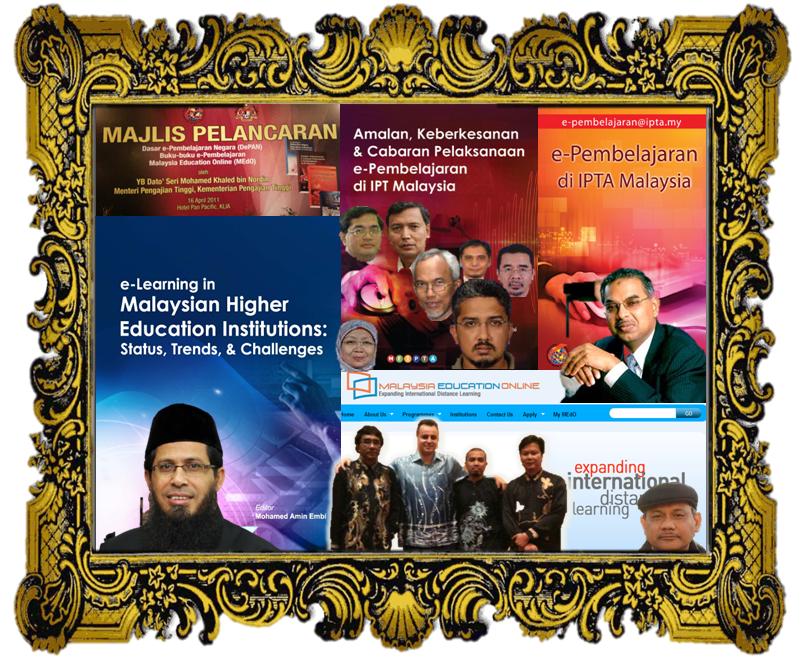
"MEdO will make Malaysia a leading brand in Asia for online higher education services and a one stop centre for learning, education and the administration of international students."
- Datuk Seri Mohd Khaled Nordin (Minister for Higher Education)
- Datuk Seri Mohd Khaled Nordin (Minister for Higher Education)
Last Saturday (16th April, 2011), I attended the "Majlis Pelancaran Dasar e-Pembelajaran Negara (DePAN), Buku-Buku e-Pembelajaran dan Malaysia Education Online (MEdO)" event launched by Datuk Seri Mohd Khaled Nordin (Minister for Higher Education).
It turned out to be a very exciting and enriching learning experience for me, and here are my discoveries and reflections...
MALAYSIA EDUCATION ONLINE (MEdO)
Malaysia Education Online (MEdO) is part of the Malaysia Government Transformation Plan (GTP) to expand international distance learning. MEdO is an online learning platform delivering education programmes from Malaysian universities, colleges, polytechnics and training institutes. It is the gateway for them to extend their global outreach whilst each participating institution is able to maintain its identity and uniqueness (more).
MEdO is initiated and led by Asia e University (AeU), which is the selected gateway university (by PEMANDU) for international education for distance and online learning. Six other Malaysian universities and institutes have already signed up to offer programmes on MEdO.
The MEdO platform itself is based on a fusion of Joomla and Moodle with some customization to suit its needs and requirements. As many universities are already using Moodle, it could speed up the learning curve (familiar environment) and adoption by educators that will be required to use it.
It will be interesting to see how this project unfolds. Let's be positive about it :)
E-BOOKS
Besides MEdO, the National E-Learning Policy (Dasar e-Pembelajaran Negara) for Higher Education Institutions, and two books (and one translation) about e-Learning in Malaysian Higher Education were launched.
Here we go:
E-LEARNING IN MALAYSIAN HIGHER EDUCATION INSTITUTIONS
I have to admit I was thrilled to discover the e-Learning in Malaysian Higher Education Institutions: Status, Trends & Challenges publication during the event. Actually, I couldn't wait and was reading it furiously during Datuk Seri Mohd Khaled Nordin's speech (please don't tell!), and what struck me most was all the juicy statistics (Yes, I just love that!) about what was going on in Higher Education in Malaysia, and the simple language used to describe the survey results and findings.
Also, the three (3) questionnaires (E-Learning Admin, Lecturer and student) used for this research were comprehensive and easy to understand (Check Appendices/page 123). The findings in the book is based on 7,962 survey respondents (26 e-Learning administrators, 1,635 lecturers and 6,301 students) from a sample of 30 Malaysian Higher Education Institutions (HEIs), comprising of 20 public HEIs, 7 private HEIs, and 3 polytechnics. As four (out of 7) e-Learning Admins from the private Universities did not participate, I suppose we could generalize that the findings mostly represent what is going on in the public HEIs in Malaysia.
Before I dwell more, I would like to introduce you to Prof Dr Mohamed Amin Embi, who was the chief editor for all the three books mentioned above. He was also the first recipient of the prestigious National Academic Award 2006, and the recipient of the distinguished ISESCO Science Laureate 2010. In other words, he is a pretty interesting guy to know. So, next time you want to know more about e-Learning in Malaysian HEIs, who are you going to call? Simple answer: Prof Dr Mohamed Amin Embi
Yes, he has also summarized nicely the key findings of each chapter in the book, and then published them on SlideShare. So, instead of summarizing the book, I can focus next on providing some of my own insights and reflections to what has been published.
Let's rumble...
Chapter 2: e-Learning Policy
So, e-learning policies is something that all HEIs should explore, but we have to be careful, and strive to find the right balance so that they empower people to learn and innovate, instead of becoming an obstacle to moving forward.
Chapter 3: e-Learning Governance
According to the survey results, the two main challenges related to the e-Learning governance are shortage of staff (84.5%) and lack of incentives provided by the HEIs to those responsible for implementing e-Learning (69.2%).
So, no doubt HEIs need to invest more in quality staff, and be creative about providing incentives (e.g. less administration and more time to think!) that inspire educators to take the effort to transform their own learning and teaching. It is strange that institutions can spend millions and millions on hardware, networks and software, but when it comes to investing in quality people and paying competitive salaries with the industry; It is so difficult!
In short, HEIs need to rethink their hiring and salary policies to capture the great talent that is out there, but are very reluctant to work in HEIs. Also, HEIs need to learn from creative companies like Google, Apple and Zappos on how to build working environments that empowers and inspires people to express their potential. Challenging, but certainly possible :)
Chapter 4: Learning Managements Systems
Though, from a learning point-of-view, we need to increasingly look beyond the LMS (they just cannot keep up with disruptive innovations taking place), as increasingly learning will take place outside in the web 2.0 (3.0/x.0) and social media worlds in the form of personal learning environments tailored to what learners and educators really want. Here is a crash course:
Chapter 5: e-Learning Training
Sadly, only one-third (34.6%) of the HEIs provide exposure to Web 2.0 applications. Though, I foresee a huge growth in the coming years of educators using Social media and web 2.0 (3.0 and x.0) beyond the LMS to facilitate more engaging and relevant learning with their students.
It will also be interesting to see how institutions deal with copyright and privacy issues, when educators and students increasingly use tools such as Facebook, Twitter, Blogs, YouTube, Wikis, etc.
Are you prepared for that? Don't wait! It is happening already!
Chapter 6: e-Content Development
One word: Ouch! Hopefully, Apple will come to its senses and allow Flash to run smoothly on an iPad, iPod or iPhone. Unless Steve Jobs retires soon that might take some time. Though, let's hope that browsers will have auto-converters, or that Flash is updated to meet all Steve Jobs requirements, otherwise e-content developed in Flash would be useless on Apple-based mobile devices. Luckily, Flash-based content works on Androids :)
The five major challenges faced by most HEIs are lack of motivation among the academic staff (65.4%), lack of specialists (53.80%), lack of a dedicated team to develop e-Content (53.8%), lack of commitment among academic staff (46.2%), and lack of funding/budget (46.2%).
Why are not academic staff motivated or committed to develop e-content? If you are already overloaded with administration, research, publication and teaching obligations, you are not going to be inspired to develop e-content for your students without some seriously good reasons.
Incentives could help (e.g. one e-content module = 1 publication in a high impact journal), but you still need to find the time. In Chapter 10 (page 119), it is proposed that common university courses could be developed jointly by a centre under the Ministry of Higher Education, as this is a more efficient use of resources, time, money, and manpower, while maintaining an acceptable level of quality.
In a nutshell, we could establish Malaysia's first official ‘Open Courseware’ initiative, which would enable all HEIs to have access and reuse (hopefully remix) freely common University courses. By doing so, then HEIs can streamline their resources to build unique e-content for their unique courses.
Based on the survey, the copyright issue is also a big problem faced by the majority (80.8%) of Malaysian HEIs in the development of e-Content. What to do? Forget Copyright, Practice Copyleft Instead!
Actually, we need to rethink our obsession with e-content development, and be more obsessed with designing relevant and engaging learning environments/spaces, where authentic learning activities play a larger role than (spoon-feeding) e-content and courseware.
Instead, HEIs students should be empowered and nurtured with the necessary learning skills to find their own content based on the learning outcomes set, or we could expose them to a variety learning resources (for each topic) and then require them to analyze, evaluate, synthesize, and then create their own contextualized meaning.
We want to develop independent lifelong learners. The e-content or courseware (spoon-feeding) model is an easy shortcut to enable them to pass the exam, but perhaps not the best way to nurture the necessary skills required for them to thrive in the 21st century.
Finally, educators need to learn the art of aggregating, filtering and remixing content from a variety of resources using a variety of learning tools out there. In a nutshell, think beyond e-content development, and focus more on nurturing educators to build sizzling learning activities and spaces for students.
In short, only develop e-content when it does not exist, or it can be synthesized or presented in a more engaging and meaningful way :)
Chapter 7: Integration of e-Learning in Teaching & Learning
According to the survey findings, lecturers' two major challenges to integrate e-Learning in their teaching and learning, is trying to balance between teaching and research (59.8%) and time constraints (54.9%). Interestingly, technophobia (13%) was the least responsible challenge among the challenges faced by lecturers in order to integrate e-Learning.
For students, the two major challenges is lack of access (53.4%), and feedback from lecturers takes too long (42.8%). By focusing less on developing e-content, lecturers will have more time to interact with their students, and construct more interactive and engaging learning environments. If we can be replaced by a courseware, then we should be replaced.
To no surprise, most lecturers (50.1%) prefer to upload materials on a weekly basis before the classes begin. Noteworthy, most students (84.7%) prefer to read the materials offline rather than online. The challenge comes when students have printed out the uploaded slides before their class (often weeks in advance), and then find out during the lecture that the slides have been updated. What do you do? Establish an e-learning policy forcing them to upload their slides at least one week before...Not a good idea! Call me to elaborate :)
On a positive note, this is a problem of today, and probably won't even exist in 3-5 years' time. Why? By then most students will be reflecting their slides on their mobile devices in the form of iPads, Kindles, Galaxy, etc.
Chapter 8: Quality Assurance
How do we ensure that our e-learning implementations are of quality? How do we ensure that our conventional learning approaches are of quality? Do we look at the drop-out rates? Or perhaps the students satisfaction levels? What about using the students' assessment results as a measure of success?
On page 119, the guidelines on e-Content standards that were developed collaboratively by CEMCA (Commonwealth of Educational Media Centre for Asia) and MOHE is recommended to be distributed and followed by all Malaysian HEIs in order to control the quality of e-Learning materials available at the tertiary level.
I disagree in using these guidelines as the standards, but it could be used as a good reference guide, like so many other guidelines out there. Personally, I don't even like the expression 'Best Practices', but instead prefer 'Good Practices'. The reason is that there is simply too much innovation and exploration still needed to be done, before we can settle down with any form of standards in E-Learning. Let's celebrate 'Good Practices' out there, and learn from them to create our own contextualized 'Good Practices'.
We want standards, but standards are often the biggest enemy to creativity and innovation. Let's not forget that!
THE FUTURE?
Not surprisingly implementing mobile learning is a priority (92.3%), according to the survey findings. Interestingly, lecturers (67%) and students (76.8%) believe that HEIs should give priority to Intelligent Tutoring Systems as compared to other applications.
Strangely enough, lecturers (23.4%) and students (19.4%) place podcasting applications as the lowest in terms of priority. Maybe it is just me, but I would prefer listening and reflecting to a great lecture over a courseware anytime of the day, no matter how interactive it may be. I suppose I am a bit weird!
If you don't have time to read the whole book, just read chapter 9 (summary) and 10 (recommendations), which will provide sufficient insights to see the big picture. Though, I would strongly recommend to enjoy all the diagrams, charts and stats spread over 120 pages.
So, what can we expect next?
Based on the suggestions given in the book (page 120), MOHE will probably soon establish 'The National Institute of e-Learning', a centre of excellence for e-Learning, that can conduct and coordinate research on e-Learning, particularly in terms of the impact of e-Learning on student achievement.
Let's hope the National Institute of e-Learning becomes an inspiring light that empowers and sparks sizzling e-learning at all HEIs.
Will I be involved?
Only God knows at this moment :)
The MEdO platform itself is based on a fusion of Joomla and Moodle with some customization to suit its needs and requirements. As many universities are already using Moodle, it could speed up the learning curve (familiar environment) and adoption by educators that will be required to use it.
It will be interesting to see how this project unfolds. Let's be positive about it :)
E-BOOKS
Besides MEdO, the National E-Learning Policy (Dasar e-Pembelajaran Negara) for Higher Education Institutions, and two books (and one translation) about e-Learning in Malaysian Higher Education were launched.
Here we go:
- National E-Learning Policy for Higher Education Institutions
(will add the link when made available) - e-Pembelajaran di IPTA Malaysia (Issuu version)
This e-book provides great insights into how especially public Universities in Malaysia are using e-learning to facilitate learning and teaching. It includes 20 University papers sharing their e-learning stories. - Amalan, Keberkesanan & Cabaran Pelaksanaan e-Pembelajaran di IPT Malaysia (Issuu version)
The English version is below... - e-Learning in Malaysian Higher Education Institutions: Status, Trends & Challenges (Issuu version)
Will be discussed next...
E-LEARNING IN MALAYSIAN HIGHER EDUCATION INSTITUTIONS
I have to admit I was thrilled to discover the e-Learning in Malaysian Higher Education Institutions: Status, Trends & Challenges publication during the event. Actually, I couldn't wait and was reading it furiously during Datuk Seri Mohd Khaled Nordin's speech (please don't tell!), and what struck me most was all the juicy statistics (Yes, I just love that!) about what was going on in Higher Education in Malaysia, and the simple language used to describe the survey results and findings.
Also, the three (3) questionnaires (E-Learning Admin, Lecturer and student) used for this research were comprehensive and easy to understand (Check Appendices/page 123). The findings in the book is based on 7,962 survey respondents (26 e-Learning administrators, 1,635 lecturers and 6,301 students) from a sample of 30 Malaysian Higher Education Institutions (HEIs), comprising of 20 public HEIs, 7 private HEIs, and 3 polytechnics. As four (out of 7) e-Learning Admins from the private Universities did not participate, I suppose we could generalize that the findings mostly represent what is going on in the public HEIs in Malaysia.
Before I dwell more, I would like to introduce you to Prof Dr Mohamed Amin Embi, who was the chief editor for all the three books mentioned above. He was also the first recipient of the prestigious National Academic Award 2006, and the recipient of the distinguished ISESCO Science Laureate 2010. In other words, he is a pretty interesting guy to know. So, next time you want to know more about e-Learning in Malaysian HEIs, who are you going to call? Simple answer: Prof Dr Mohamed Amin Embi
We have met a couple of times, but I suppose I need to bug him more from now on. Actually, I bugged him through e-mail a few days back to publish these 3 books on Issuu or Scribd, and within a couple of days they were published on both. Great guy!
Yes, he has also summarized nicely the key findings of each chapter in the book, and then published them on SlideShare. So, instead of summarizing the book, I can focus next on providing some of my own insights and reflections to what has been published.
Let's rumble...
Chapter 2: e-Learning Policy
e-Learning policy
Here are few questions we should perhaps ask before even thinking about formulating or requiring HEIs to have e-learning policies: View more presentations from Mohamed Amin Embi
- Do we need to have e-learning policies to make e-learning work for us?
- Who should be involved in formulating e-learning policies (all stakeholders, including students)?
- How detailed should e-learning policies be (any template)?
- Can e-learning policies have a negative impact on implementing e-learning?
- Should the Ministry of Higher Education (MOHE) have a mechanism to enforce all HEIs to have e-learning policies?
So, e-learning policies is something that all HEIs should explore, but we have to be careful, and strive to find the right balance so that they empower people to learn and innovate, instead of becoming an obstacle to moving forward.
Chapter 3: e-Learning Governance
e-learning governance
View more presentations from Mohamed Amin Embi
According to the survey results, the two main challenges related to the e-Learning governance are shortage of staff (84.5%) and lack of incentives provided by the HEIs to those responsible for implementing e-Learning (69.2%).
So, no doubt HEIs need to invest more in quality staff, and be creative about providing incentives (e.g. less administration and more time to think!) that inspire educators to take the effort to transform their own learning and teaching. It is strange that institutions can spend millions and millions on hardware, networks and software, but when it comes to investing in quality people and paying competitive salaries with the industry; It is so difficult!
In short, HEIs need to rethink their hiring and salary policies to capture the great talent that is out there, but are very reluctant to work in HEIs. Also, HEIs need to learn from creative companies like Google, Apple and Zappos on how to build working environments that empowers and inspires people to express their potential. Challenging, but certainly possible :)
Chapter 4: Learning Managements Systems
Learning Management Systems
Interestingly, All (100%) HEIs that participated had their own Learning Management System (LMS), and more than half (57.7%) of the HEIs used Open Source Platforms, while 34.6% used purchased commercial LMS, and the remaining 15.4% were developed on their own. In this survey, Moodle beat Blackboard (12 - 2) impressively, but if we were to include more private HEIs the results would be a bit darker :) View more presentations from Mohamed Amin Embi
Though, from a learning point-of-view, we need to increasingly look beyond the LMS (they just cannot keep up with disruptive innovations taking place), as increasingly learning will take place outside in the web 2.0 (3.0/x.0) and social media worlds in the form of personal learning environments tailored to what learners and educators really want. Here is a crash course:
Chapter 5: e-Learning Training
e-learning training
View more presentations from Mohamed Amin Embi
Sadly, only one-third (34.6%) of the HEIs provide exposure to Web 2.0 applications. Though, I foresee a huge growth in the coming years of educators using Social media and web 2.0 (3.0 and x.0) beyond the LMS to facilitate more engaging and relevant learning with their students.
It will also be interesting to see how institutions deal with copyright and privacy issues, when educators and students increasingly use tools such as Facebook, Twitter, Blogs, YouTube, Wikis, etc.
Are you prepared for that? Don't wait! It is happening already!
Chapter 6: e-Content Development
e-content development
The main applications used for e-Content development are Flash (92.3%), followed by Articulate (46.3%), Adobe Captivate (38.3%), Camtasia Studio (30.8%), Lecture Maker (15.42%), and Interactive Raptivity Builder ( 15.4%). View more presentations from Mohamed Amin Embi
One word: Ouch! Hopefully, Apple will come to its senses and allow Flash to run smoothly on an iPad, iPod or iPhone. Unless Steve Jobs retires soon that might take some time. Though, let's hope that browsers will have auto-converters, or that Flash is updated to meet all Steve Jobs requirements, otherwise e-content developed in Flash would be useless on Apple-based mobile devices. Luckily, Flash-based content works on Androids :)
The five major challenges faced by most HEIs are lack of motivation among the academic staff (65.4%), lack of specialists (53.80%), lack of a dedicated team to develop e-Content (53.8%), lack of commitment among academic staff (46.2%), and lack of funding/budget (46.2%).
Why are not academic staff motivated or committed to develop e-content? If you are already overloaded with administration, research, publication and teaching obligations, you are not going to be inspired to develop e-content for your students without some seriously good reasons.
Incentives could help (e.g. one e-content module = 1 publication in a high impact journal), but you still need to find the time. In Chapter 10 (page 119), it is proposed that common university courses could be developed jointly by a centre under the Ministry of Higher Education, as this is a more efficient use of resources, time, money, and manpower, while maintaining an acceptable level of quality.
In a nutshell, we could establish Malaysia's first official ‘Open Courseware’ initiative, which would enable all HEIs to have access and reuse (hopefully remix) freely common University courses. By doing so, then HEIs can streamline their resources to build unique e-content for their unique courses.
Based on the survey, the copyright issue is also a big problem faced by the majority (80.8%) of Malaysian HEIs in the development of e-Content. What to do? Forget Copyright, Practice Copyleft Instead!
Actually, we need to rethink our obsession with e-content development, and be more obsessed with designing relevant and engaging learning environments/spaces, where authentic learning activities play a larger role than (spoon-feeding) e-content and courseware.
Instead, HEIs students should be empowered and nurtured with the necessary learning skills to find their own content based on the learning outcomes set, or we could expose them to a variety learning resources (for each topic) and then require them to analyze, evaluate, synthesize, and then create their own contextualized meaning.
We want to develop independent lifelong learners. The e-content or courseware (spoon-feeding) model is an easy shortcut to enable them to pass the exam, but perhaps not the best way to nurture the necessary skills required for them to thrive in the 21st century.
Finally, educators need to learn the art of aggregating, filtering and remixing content from a variety of resources using a variety of learning tools out there. In a nutshell, think beyond e-content development, and focus more on nurturing educators to build sizzling learning activities and spaces for students.
In short, only develop e-content when it does not exist, or it can be synthesized or presented in a more engaging and meaningful way :)
Chapter 7: Integration of e-Learning in Teaching & Learning
According to the survey findings, lecturers' two major challenges to integrate e-Learning in their teaching and learning, is trying to balance between teaching and research (59.8%) and time constraints (54.9%). Interestingly, technophobia (13%) was the least responsible challenge among the challenges faced by lecturers in order to integrate e-Learning.
For students, the two major challenges is lack of access (53.4%), and feedback from lecturers takes too long (42.8%). By focusing less on developing e-content, lecturers will have more time to interact with their students, and construct more interactive and engaging learning environments. If we can be replaced by a courseware, then we should be replaced.
To no surprise, most lecturers (50.1%) prefer to upload materials on a weekly basis before the classes begin. Noteworthy, most students (84.7%) prefer to read the materials offline rather than online. The challenge comes when students have printed out the uploaded slides before their class (often weeks in advance), and then find out during the lecture that the slides have been updated. What do you do? Establish an e-learning policy forcing them to upload their slides at least one week before...Not a good idea! Call me to elaborate :)
On a positive note, this is a problem of today, and probably won't even exist in 3-5 years' time. Why? By then most students will be reflecting their slides on their mobile devices in the form of iPads, Kindles, Galaxy, etc.
Chapter 8: Quality Assurance
Quality Assurance in e-Learning
View more presentations from Mohamed Amin Embi
How do we ensure that our e-learning implementations are of quality? How do we ensure that our conventional learning approaches are of quality? Do we look at the drop-out rates? Or perhaps the students satisfaction levels? What about using the students' assessment results as a measure of success?
On page 119, the guidelines on e-Content standards that were developed collaboratively by CEMCA (Commonwealth of Educational Media Centre for Asia) and MOHE is recommended to be distributed and followed by all Malaysian HEIs in order to control the quality of e-Learning materials available at the tertiary level.
I disagree in using these guidelines as the standards, but it could be used as a good reference guide, like so many other guidelines out there. Personally, I don't even like the expression 'Best Practices', but instead prefer 'Good Practices'. The reason is that there is simply too much innovation and exploration still needed to be done, before we can settle down with any form of standards in E-Learning. Let's celebrate 'Good Practices' out there, and learn from them to create our own contextualized 'Good Practices'.
We want standards, but standards are often the biggest enemy to creativity and innovation. Let's not forget that!
THE FUTURE?
Not surprisingly implementing mobile learning is a priority (92.3%), according to the survey findings. Interestingly, lecturers (67%) and students (76.8%) believe that HEIs should give priority to Intelligent Tutoring Systems as compared to other applications.
Strangely enough, lecturers (23.4%) and students (19.4%) place podcasting applications as the lowest in terms of priority. Maybe it is just me, but I would prefer listening and reflecting to a great lecture over a courseware anytime of the day, no matter how interactive it may be. I suppose I am a bit weird!
If you don't have time to read the whole book, just read chapter 9 (summary) and 10 (recommendations), which will provide sufficient insights to see the big picture. Though, I would strongly recommend to enjoy all the diagrams, charts and stats spread over 120 pages.
So, what can we expect next?
Based on the suggestions given in the book (page 120), MOHE will probably soon establish 'The National Institute of e-Learning', a centre of excellence for e-Learning, that can conduct and coordinate research on e-Learning, particularly in terms of the impact of e-Learning on student achievement.
Let's hope the National Institute of e-Learning becomes an inspiring light that empowers and sparks sizzling e-learning at all HEIs.
Will I be involved?
Only God knows at this moment :)
Wednesday, March 9
Kable.MY - Malaysia's Premiere Instructional Technology Website

"This website provides the latest news, articles and tutorials on emerging technologies for educational purposes, and serves as a hub for educators to congregate and share ideas that can be put into practice. It is hoped that this website will be on the forefront of Malaysia's instructional technology and inspire educators to use technologies to enhance their instructions."
NEW!
19 hours ago, I got a pleasant e-mail from Hafiz Hanif, who invited me to visit his new Kable.MY website. I was also invited to be a freelance writer for the website, but I told him instead of being a freelance writer, why not use whatever you like from ZaidLearn, and then link back to the original post (article). The reason is that whatever I write to share (to anyone), I will post it on ZaidLearn (First!). Anyway, this post is not about ZaidLearn, but about this awesome Kable.MY website that I just discovered, thanks to Hafiz Hanif.
Although, Kable.MY is still brand new, and probably needs some time to build up a substantial collection of awesome articles (unless they reuse with attribution and permission from great Edubloggers out there), I am really impressed with the website design, and the first few articles too are very useful and relevant.
INSPIRING!
Also, I like their team's learning philosophy and spirit:
"We are a bunch of normal educators like you, with the enthusiasm to provide the latest and fun ways to teach students, to inspire them with the use of technologies that are often regarded as a separate entity from our instructional strategies. Here, we share our thoughts on how to integrate technologies into your everyday teaching and learning activities, and how to understand the design of certain applications, how to re-purpose the applications to suit our educational needs, and how to get control over our own methodological strategies (Source)."
Yes, certainly a good start! The challenge is to keep that volcanic creative eruption continuously flowing, and if the passion and focus is there... WOW, this could evolve into something really special!
Thinking of it, after being inspired by Kable.MY's awesome website design, I believe it is time to relook and rethink the website design of ZaidLearn, which has not really changed much since its inception. But then again, neither has Google's homepage either. But, then again I have yet to find that swoosh factor that fits ZaidLearn's flavor and content. One thing for sure, I would want the revamped website to infuse a lot of (white) dreaming space free from anything.
I believe it is time to erupt some changes soon...Need another 102 days to think about it!
Kable.MY, thanks for this inspiring website, and hopefully it will inspire more educators in Malaysia to share their learning stories and tips. Yes, why not :)
Saturday, January 22
The One Stop Learning Blog

ONE STOP LEARNING
"As I have progressed along my journey as an educator, I have come to better appreciate that teaching is about sharing—sharing what I have learned with others, including the public at large. This blog is my expression, my way of sharing my passion on the issue of teaching and learning, lifelong learning and education in general. It is also intended as a repository of resources related to teaching and learning. This is my humble attempt to put together useful links, articles, websites, presentations, videos, etc. in one place -- for my own reference and for those who are interested to learn more about teaching and learning...more"
I am always thrilled to discover new edublogs from educators in Higher Education in Malaysia passionate about sharing their learning discoveries and journeys. This blog by Prof. Karim has already been around since November 2010, so it is not totally new, but without doubt worth sharing here. Interestingly, we met during a workshop (National E-Learning Road Map) late last year (2010), and have since communicated through Twitter (@biopolimer) and e-mail, but ironically I didn't really discover his juicy blog until today.
As the One Stop Learning blog is also Prof. Karim's own reference for learning discoveries on teaching and learning, means that his motivation to keep it going goes beyond hits and fame, which is important to keep it rolling until the world discovers this gem of a blog. Besides being self-motivated to share, it is always great to know that you have readers and people willing to challenge your ideas and thoughts. If he can keep it up (like now!), I am pretty sure that this blog will achieve just that as it explores and grows.
In short, why not visit...I shall say no more... just CLICK HERE :)
- Professor Karim (Universiti Sains Malaysia)
I am always thrilled to discover new edublogs from educators in Higher Education in Malaysia passionate about sharing their learning discoveries and journeys. This blog by Prof. Karim has already been around since November 2010, so it is not totally new, but without doubt worth sharing here. Interestingly, we met during a workshop (National E-Learning Road Map) late last year (2010), and have since communicated through Twitter (@biopolimer) and e-mail, but ironically I didn't really discover his juicy blog until today.
As the One Stop Learning blog is also Prof. Karim's own reference for learning discoveries on teaching and learning, means that his motivation to keep it going goes beyond hits and fame, which is important to keep it rolling until the world discovers this gem of a blog. Besides being self-motivated to share, it is always great to know that you have readers and people willing to challenge your ideas and thoughts. If he can keep it up (like now!), I am pretty sure that this blog will achieve just that as it explores and grows.
In short, why not visit...I shall say no more... just CLICK HERE :)
Wednesday, January 12
IMU Student Blogging Project to Promote a Healthy Lifestyle!

"Every blog has a story behind it."
THE STORY
In late October 2010, Sheba DMani, the coordinator (facilitator) for the 'A Critical and Reflective Response to Media' (Medical Humanities Selective) course (at IMU) explored with me the idea of assigning students to work in groups to develop blogs addressing important issues and promoting a healthy lifestyle.
Of course that made me excited, as I have been promoting the usage of web 2.0 and social media for learning ever since I joined IMU (June 2009). And having already been through one cycle assisting Prof. Khoo Suan Phaik with her students' project using Google Sites, I was quite confident it would be an inspiring and valuable learning experience.
Of course that made me excited, as I have been promoting the usage of web 2.0 and social media for learning ever since I joined IMU (June 2009). And having already been through one cycle assisting Prof. Khoo Suan Phaik with her students' project using Google Sites, I was quite confident it would be an inspiring and valuable learning experience.
Interestingly, both these inspiring lecturers are not exactly IT-savvy, but they were willing and open to explore possibilities, and with a bit of assistance they managed to get through both projects successfully without too much hassle. As today's Y-generation (Most IMU students) is already quite IT-savvy, you don't exactly need to train them, but instead explore and empower them with creative ideas and possibilities.
A CRITICAL & REFLECTIVE RESPONSE TO MEDIA
This module facilitated by Sheba DMani focuses on connections between media and health within socio-cultural contexts. Media in the form of text and graphic presented through visual and audio modes from magazines, television and internet will be explored. These may include advertisements, films and music videos related to themes on health and healthcare. Students will approach these media texts through critical interpretation, reflective thinking and creative presentations. Upon completing this course, students will have learned that the media constructs views of the real world and that these views have been mediated to provide filtered and partial meaning of health belief and behaviour.
A CRITICAL & REFLECTIVE RESPONSE TO MEDIA
This module facilitated by Sheba DMani focuses on connections between media and health within socio-cultural contexts. Media in the form of text and graphic presented through visual and audio modes from magazines, television and internet will be explored. These may include advertisements, films and music videos related to themes on health and healthcare. Students will approach these media texts through critical interpretation, reflective thinking and creative presentations. Upon completing this course, students will have learned that the media constructs views of the real world and that these views have been mediated to provide filtered and partial meaning of health belief and behaviour.
THE PROJECT & EVALUATION PROCESS
So, instead of writing a group assignment (using Microsoft Word/PowerPoint) to impress the lecturer, students were assigned to create a blog and promote their mission to the world. Surely that is more inspiring and exciting, right?
The students were assigned randomly into groups (consisting of 10 or less) and had three weeks (29 Nov-17 Dec) to prepare the blog, before presenting their project to the class and a selected group of evaluators. The blogs purpose was to promote health information to a specific audience (i.e. children, teenagers, adults, special needs and pregnant women).
The blogs would be evaluated based on their originality and creativity (title, tag-line, content, etc.), and the blog had to include at least 3 articles/columns and/or editorials that convey messages on the chosen topic. Finally, each blog had to include at least one video or audio message developed by the group.
The blogs would be evaluated based on their originality and creativity (title, tag-line, content, etc.), and the blog had to include at least 3 articles/columns and/or editorials that convey messages on the chosen topic. Finally, each blog had to include at least one video or audio message developed by the group.
Strong emphasis was given on originality, and students were reminded the importance of avoiding plagiarism and dealing with risk communication. In other words, it is important to acknowledge and appreciate authors and sources (re)used to develop the content for the blogs.
Overall, the blogs were assessed for accuracy and relevance of information, creativity, interactive features and the use of media techniques. To make it more exciting and competitive, each group did not make their blogs available to the other groups (or public) before their group presentation on the 16th December (2010).
Each group was given 30 minutes to present and defend their blog on the 16 December. Interestingly, Assoc. Prof. Dr. SriKumar Chakravarthi (IMU lecturer) whom was one of the evaluators was in India during this period, but still managed to watch and participate in the evaluation process using Skype. In addition to getting feedback from other class mates and evaluators, students voted for their favorite blog (using the Moodle poll feature) after the group presentation.
So, what was my role besides being one of the evaluators? As Sheba DMani is not too familiar with blogging, I handled a Q&A session on creating a blog with the students on the 3rd December. No, I didn't present any PowerPoint slides! I simply came to class, asked them relevant questions, and explored possibilities from this awesome list of free learning tools they could use to create or reuse sizzling content for their blogs.
So, how much did this project cost? In terms of technology, all the online tools they used to spread their message to the world cost.... ZERO! Not bad!
STUDENT LEARNING OUTPUT?
 "Healthy foods for a healthy baby"
This blog aims to guide pregnant women through the process of making a positive change in the diet. It discusses and explores nutrition tips, delicious recipes, common myths, pregnancy tips and no-nos, useful links, and a few cool widgets, including the 'Weekly Pregnancy Calendar'. Overall, the blog is well-designed providing the user with a visually soothing and user-friendly navigation experience, which is certainly a requirement for any pregnant woman.
The project team (Amelia, Melisa, Moushini, Natasha, Ray, Shahira, and Sharon) did a great collaborative effort. Congratulations!
The project team (Amelia, Melisa, Moushini, Natasha, Ray, Shahira, and Sharon) did a great collaborative effort. Congratulations!
In one word: Wonderful!
 "Teenage Life is Never Black & White"
 This blog focuses on adolescent issues aimed at the teenage population of 13-19. It explores in an emotionally creative, but informative way common youth challenges such as alcohol, drugs, relationships (family/friends/girlfriend/boyfriend), stress and smoking.
To really connect with the youth in an inspiring and engaging way, this hard working project team mashed-up their own original graphics, directed and recorded a short Abstinence Educational Video, set up a Facebook page, and used Xtranormal to create this cool animated video:
In one word: AWESOME!
 "BIG or small, We Save them All"
This blog aims to provide a one stop avenue for information on breast cancer in an easy way to understand. Its' combination of stylish (pink) and interactive design, easy navigation, and relevant topics makes it a great place to discover more about breast cancer, which include symptoms, risk factors, preventive measures, test and diagnosis, and alternative medicine. In addition to developing a great website, the project team (Qi Quan, Melody, Wern Ching, Shariffa and Praveena) developed a very informative 'Breast Self-Examination' video...
 This blog focuses on Asperger's Syndrome, which is often misunderstood among people. Asperger's Syndrome is an autism spectrum disorder that is characterized by significant difficulties in social interaction, along with restricted and repetitive patterns of behavior and interests. The project team has done a good job in designing and structuring the few (identified), but relevant issues regarding this disability, which include helping people to recognize it, statistics and epidemiology, books and resources, and famous people with it. Did you know that Albert Einstein had Asperger's Syndrome? Now you know!
In one word: INTERESTING!

In one word: CREATIVE!
LESSONS LEARNED
 This blog focuses on Asperger's Syndrome, which is often misunderstood among people. Asperger's Syndrome is an autism spectrum disorder that is characterized by significant difficulties in social interaction, along with restricted and repetitive patterns of behavior and interests. The project team has done a good job in designing and structuring the few (identified), but relevant issues regarding this disability, which include helping people to recognize it, statistics and epidemiology, books and resources, and famous people with it. Did you know that Albert Einstein had Asperger's Syndrome? Now you know!
In one word: INTERESTING!

"Don't Forget to Brush Your Teeth"
This blog provides some useful tips on how to take care of your health, including brushing your teeth, eating oranges and carrots, and washing your hands. The highlight of this blog has to be the creatively designed video developed by the project team (view contributors), entitled "The story of Bluey and Pinky'.In one word: CREATIVE!
From my experience working with students involved in projects requiring them to develop a website (using web 2.0), often complain that it is time consuming and that it requires a lot of work. But by knowing that their work will continue to live on (more meaning), and that they are publishing it to the world (instead of only to the lecturer), they are willing to take up the challenge and put in a greater effort. In other words, their motivation often goes beyond grades, and that is very exciting and encouraging.
Though, we still have to work on their fair use or reuse of external content and graphics, and teach them proper online referencing procedures, which is something we have to continue to work on. It is alright to quote and reuse (if permission is given), but we must appreciate and recognize other people's work. As such we have already setup a site for IMU staff and students (only) exploring project based learning (in the e-learning portal), including proper online referencing procedures.
Although, our e-learning portal (using Moodle) is wonderful for uploading and organizing course content, linking online resources, online discussions, assignment submissions, online quizzes, and so on, we should also encourage and empower students to use other web 2.0 and social media tools for creating creative content and informal learning. For example, several lecturers from the School of Pharmacy use Facebook for communicating online with their students, and have experimented with conducting Problem-Based Learning (PBL) sessions using Facebook Groups.
I have noticed that some Universities in Malaysia ban the usage of Facebook and YouTube at their campuses, and use the excuse that they encourage poor learning/working habits and clog up their network (bandwidth) for other usages. That might be true, but if staff and students learn how to discipline themselves using such tools (no choice!), they will actually have access to some of the most amazing learning resources on the planet (for free), and be able to interact with experts and students from all over the world through Facebook groups/pages (e.g. Harvard University - Facebook). I can't think of a better investment for learning than boosting the network (bandwidth) to support online learning in all forms. The Internet is the heart, blood circulation, and oxygen of learning in the 21st century.
More importantly, today more than ever, it is critical to encourage students to nurture their communication, collaboration, creative and analytical skills using the web and multimedia tools. Increasingly in the future, people in organizations will be working and collaborating online using the cloud, so it is important to encourage and necessary to prepare our students for this new world.
Also, it is important to highlight here that the quality of the students' output (results) at this stage is not as important as empowering their passionate and inquiring mindset to explore possibilities and ideas, and continuously reflect, learn and improve from these learning experiences. In short, focus more on the learning process than the output (results). Results will come as they learn. Some are early bloomers, others are late bloomers, and that is something we should never forget.
Can you imagine hiring a graduate that cannot communicate and collaborate online? Try asking that same question in four year's time :)
Though, we still have to work on their fair use or reuse of external content and graphics, and teach them proper online referencing procedures, which is something we have to continue to work on. It is alright to quote and reuse (if permission is given), but we must appreciate and recognize other people's work. As such we have already setup a site for IMU staff and students (only) exploring project based learning (in the e-learning portal), including proper online referencing procedures.
Although, our e-learning portal (using Moodle) is wonderful for uploading and organizing course content, linking online resources, online discussions, assignment submissions, online quizzes, and so on, we should also encourage and empower students to use other web 2.0 and social media tools for creating creative content and informal learning. For example, several lecturers from the School of Pharmacy use Facebook for communicating online with their students, and have experimented with conducting Problem-Based Learning (PBL) sessions using Facebook Groups.
I have noticed that some Universities in Malaysia ban the usage of Facebook and YouTube at their campuses, and use the excuse that they encourage poor learning/working habits and clog up their network (bandwidth) for other usages. That might be true, but if staff and students learn how to discipline themselves using such tools (no choice!), they will actually have access to some of the most amazing learning resources on the planet (for free), and be able to interact with experts and students from all over the world through Facebook groups/pages (e.g. Harvard University - Facebook). I can't think of a better investment for learning than boosting the network (bandwidth) to support online learning in all forms. The Internet is the heart, blood circulation, and oxygen of learning in the 21st century.
More importantly, today more than ever, it is critical to encourage students to nurture their communication, collaboration, creative and analytical skills using the web and multimedia tools. Increasingly in the future, people in organizations will be working and collaborating online using the cloud, so it is important to encourage and necessary to prepare our students for this new world.
Also, it is important to highlight here that the quality of the students' output (results) at this stage is not as important as empowering their passionate and inquiring mindset to explore possibilities and ideas, and continuously reflect, learn and improve from these learning experiences. In short, focus more on the learning process than the output (results). Results will come as they learn. Some are early bloomers, others are late bloomers, and that is something we should never forget.
Can you imagine hiring a graduate that cannot communicate and collaborate online? Try asking that same question in four year's time :)
Wednesday, December 8
Islam, Higher Education & The Virtual Campus!

"When the son of Adam (human being) dies, his deeds are stopped except for three things, namely, his good deeds, his knowledge, and his pious child who prays for him."
- Prophet Muhammad (PBUH)
In this context, 'his knowledge' means knowledge that benefit others (including written materials such as articles, papers, books, etc.). Not only what has been learned, but more importantly what has been shared. So, sharing knowledge is not only a good thing to do, it is a form of worship in Islam. So, let's practice it sincerely (whether we are Muslim or not)!
TWO CONFERENCES
A couple of weeks back (9-11 November), I attended and participated in two (2) very interesting conferences (Oops, I mean one conference & one forum!):
- International Conference On Islam And Higher Education (8-9 November)
- Future Campus Forum Malaysia (10-11 November)
As for the first conference, I could only attend the 2nd day (9th November), as I was stuck with other work commitments. Overall, these two events where enriching and enlightening (in their own ways), and now I will share some insights (lessons learned) and explore how we could face some of the challenges ahead.
ISLAM & HIGHER EDUCATION
Actually, I was invited to moderate the e-learning session just a few days before the conference. For whatever reason that may be (the original moderator pulled out, poor planning, etc.), I don't care, except that I was delighted to get the call, and obviously agreed to take up the challenge. As I have never moderated a session at an International Conference, how could I say 'NO' to such a great challenge.
9th NOVEMBER
I attended all the sessions at the International Conference On Islam And Higher Education (download the presentation slides) on the 9th November, as I was interested to listen and get some insights into how different countries and communities are struggling to infuse more Islamic teachings and values into their mainstream education models. Of course, if FOX News was here, they would paint a different picture saying ______, and I would be on CIA's most wanted list.
But, getting back to reality, it was heartening and enlightening that most have realized that investing in education and moving forward is NON-Brainer. I had the opportunity to listen to speakers discuss Islam and (mostly Higher) education in India, Philippines, Thailand, Indonesia, Iran, Tanzania, Kazakhstan and Malaysia.
No doubt, we (Muslims) have many challenges ahead, but investing heavily and smartly in education could do wonders to deal with many of them. No doubt, dropping bombs from 30,000 feet is not going bring Muslims closer to the West (or accomplish the mission, except amplify hate. Obama, time to wake up!), but also Muslims have to realize that there are plenty of peaceful loving people in the West, and just brushing everyone under one monster roof is not the solution. We both have to do some soul searching (Including me!), and educating and connecting people (besides using Facebook!) is a great way to infuse greater understanding and move forward.
GLOBAL WARMING!
Yes, moving forward together to solve mission nearly impossible, which is mankind's authentic TERRORISM AGAINST MOTHER EARTH! Whether 'Global Warming' is a fact or myth, I cannot verify, but what I do know is that mankind is abusing the Earth beyond its capacity (by __%), and unless we change or transform the way we live soon, we are not providing much hope for our future generations. But, on a positive note this disaster in the making (or made!) will increasingly bring us together around the world, and eventually we will have to put our differences aside (for a while), so that we can clean up our own mess. Shame on mankind, shame on me! I suppose I am dreamer, but why not? I am still learning! Let's get back to the conference...
HIGHER EDUCATION IN THE MUSLIM WORLD
Although, some might argue that Universities will be extinct soon (like the dinosaurs), unless they transform the way they facilitate and assess learning, they are still very much needed (for reasons also beyond learning), an e-Learning can play a vital role to empower more people to be educated. As you see in the diagram below, we have a long way to go to ensure that all in the Muslim world (15 selected countries) have the opportunity to continue their education:

Professor Dato’ Dr. Ansary Ahmed's insightful an stimulating talk (PDF) during the e-Learning session (which I moderated) went beyond wishful thinking, and provided us with hardcore (sad) numbers and some excellent thoughts on moving forward.
The other speaker during the e-learning session, Professor Dr. Ahmad Memariani Azizolah from Iran (FOX News, please chill!), explored Payame Noor University (PNU), Iran: A Universal Distance-Based University in the Islamic World, which I found truly mind boggling. For example, The University has 485 centers throughout the country supported by 3500 teaching staff and the student population exceeds 1,100,000, which means roughly 314 students to one teacher. WOW! To put this into perspective, Oxford University has a ratio of 3 students to one teacher. How can one ensure quality University education with such a student-teacher ratio (314 to 1)? Any magic formulas to share?
In 1979 the access to higher education in Iran was just 5% . Today the PNU and Islamic Azad University (1,200,000 students in regular programs!) cover approximately 65% of the students. And Al-Mustafa Open University (a virtual Islamic University) attracts more than 18000 international students from more than 100 countries. Again, WOW!
Having also witnessed (2 trips) the tremendous growth and emphasis on education and e-learning (e.g. National Center for e-Learning & Distance Learning) in Saudi Arabia over the last two (2) years, it is an exciting time to be working in the education world. I was fortunate to be part of the first e-Learning audit team that visited eight (8) Universities earlier this year, and it was very encouraging to see the passion and drive in Saudi Arabia to transform the education system (more input here). Actually, the whole Middle East is going through a massive transformation, and education and e-learning is increasingly playing a critical role.
MOVING FORWARD?
But, we still have a long but exciting way to go, and here are three (3) transformative things that I recommend that we should focus on to really take-off:
![[free+internet.JPG]](https://blogger.googleusercontent.com/img/b/R29vZ2xl/AVvXsEjvB9cWFtbtkiN7INqAfnSrJ7EZ6g_Offtw0491SM1huTZXViyIwvvqNlNCihI4Z4eU_STOeDbDN8bVRgSEbs0-iXh5ycJIOyihHQnmAM6n33GBzvFv2XUS1LgW8lgpybPki_osC1tWI7Q/s1600/free+internet.JPG)
That brings me back to this conference, and the problem with most conferences (that I have attended) is that when completed, I suffer from information overload and exhaustion. In other words, how can we transform conferences to become less bla, bla, bla... to be more engaging & interactive?
9th NOVEMBER
I attended all the sessions at the International Conference On Islam And Higher Education (download the presentation slides) on the 9th November, as I was interested to listen and get some insights into how different countries and communities are struggling to infuse more Islamic teachings and values into their mainstream education models. Of course, if FOX News was here, they would paint a different picture saying ______, and I would be on CIA's most wanted list.
But, getting back to reality, it was heartening and enlightening that most have realized that investing in education and moving forward is NON-Brainer. I had the opportunity to listen to speakers discuss Islam and (mostly Higher) education in India, Philippines, Thailand, Indonesia, Iran, Tanzania, Kazakhstan and Malaysia.
No doubt, we (Muslims) have many challenges ahead, but investing heavily and smartly in education could do wonders to deal with many of them. No doubt, dropping bombs from 30,000 feet is not going bring Muslims closer to the West (or accomplish the mission, except amplify hate. Obama, time to wake up!), but also Muslims have to realize that there are plenty of peaceful loving people in the West, and just brushing everyone under one monster roof is not the solution. We both have to do some soul searching (Including me!), and educating and connecting people (besides using Facebook!) is a great way to infuse greater understanding and move forward.
GLOBAL WARMING!
Yes, moving forward together to solve mission nearly impossible, which is mankind's authentic TERRORISM AGAINST MOTHER EARTH! Whether 'Global Warming' is a fact or myth, I cannot verify, but what I do know is that mankind is abusing the Earth beyond its capacity (by __%), and unless we change or transform the way we live soon, we are not providing much hope for our future generations. But, on a positive note this disaster in the making (or made!) will increasingly bring us together around the world, and eventually we will have to put our differences aside (for a while), so that we can clean up our own mess. Shame on mankind, shame on me! I suppose I am dreamer, but why not? I am still learning! Let's get back to the conference...
HIGHER EDUCATION IN THE MUSLIM WORLD
Although, some might argue that Universities will be extinct soon (like the dinosaurs), unless they transform the way they facilitate and assess learning, they are still very much needed (for reasons also beyond learning), an e-Learning can play a vital role to empower more people to be educated. As you see in the diagram below, we have a long way to go to ensure that all in the Muslim world (15 selected countries) have the opportunity to continue their education:

Professor Dato’ Dr. Ansary Ahmed's insightful an stimulating talk (PDF) during the e-Learning session (which I moderated) went beyond wishful thinking, and provided us with hardcore (sad) numbers and some excellent thoughts on moving forward.
The other speaker during the e-learning session, Professor Dr. Ahmad Memariani Azizolah from Iran (FOX News, please chill!), explored Payame Noor University (PNU), Iran: A Universal Distance-Based University in the Islamic World, which I found truly mind boggling. For example, The University has 485 centers throughout the country supported by 3500 teaching staff and the student population exceeds 1,100,000, which means roughly 314 students to one teacher. WOW! To put this into perspective, Oxford University has a ratio of 3 students to one teacher. How can one ensure quality University education with such a student-teacher ratio (314 to 1)? Any magic formulas to share?
In 1979 the access to higher education in Iran was just 5% . Today the PNU and Islamic Azad University (1,200,000 students in regular programs!) cover approximately 65% of the students. And Al-Mustafa Open University (a virtual Islamic University) attracts more than 18000 international students from more than 100 countries. Again, WOW!
Having also witnessed (2 trips) the tremendous growth and emphasis on education and e-learning (e.g. National Center for e-Learning & Distance Learning) in Saudi Arabia over the last two (2) years, it is an exciting time to be working in the education world. I was fortunate to be part of the first e-Learning audit team that visited eight (8) Universities earlier this year, and it was very encouraging to see the passion and drive in Saudi Arabia to transform the education system (more input here). Actually, the whole Middle East is going through a massive transformation, and education and e-learning is increasingly playing a critical role.
MOVING FORWARD?
But, we still have a long but exciting way to go, and here are three (3) transformative things that I recommend that we should focus on to really take-off:
- Free Internet Access is a Fundamental Human Right!
Internet is the oxygen of learning in the 21st century, and without it we are denying millions (1.57 billion Muslims around the world) of people access to learn (e.g. free learning resources), even if educational institutions have no space for them. Also, the Internet provides people an amazing platform (ecosystem) to connect, network, innovate, and do business directly and indirectly.
As of 1 July this year (2010) "every Finn will have the right to access to a 1Mbps (megabit per second) broadband connection. Finland has vowed to connect everyone to a 100Mbps connection by 2015 (Source)." In short, we must realize the importance and the empowering impact the Internet can have on society and education, and therefore should do everything possible to make it happen. Of course, the Internet can be used to do negative stuff, but that is a challenge we have little choice, but to face. If that means sometimes censoring sites, fine, but do not censor the Internet itself, which is probably the surest way to self-destruct in the 21st century. Let's think beyond, and envision Internet (and learning devices) for all! It might sound impossible now, but it is not! We, just need to rethink the way we think, and put our energies and passions in the right direction(s)! - Forget Copyright, Practice Copyleft Instead!
Isn't it weird that we can actually copyright and sell knowledge that was created by others, but synthesized, paraphrased, and mashed-up by ourselves. Oops, I forgot, we contributed say 5% originality. What right do we have to copyright and sell such knowledge? We can argue that we invested time synthesizing it, referenced resources used, but does that take the fact away that many academic textbooks today are often just a collection of other people's work wrapped nicely up into a sizzling cover, which we glorify and sell as if we are the masters of the universe. Some people do actually make a (necessary) living from it, fine! But, to the rest who already make a decent living, let's practice the greatest passion of a true academic, which is to share what we learn to as many people as we possibly can. Today with the Internet and tons of amazing free learning tools we can reach anyone in the world that has access to the Internet without needing to invest much, except our time.
Maybe I am wrong here, or maybe it is that I am left handed, and as a result I find copyright so difficult to appreciate (especially in the academic world). Anyway, now that we can easily Copyleft (Confused? Click the link!), or use Creative Commons, we should think beyond copyright, and explore sharing more for the benefit of everyone (except the publishers). Also, if we argue that a University would lose its competitive edge by sharing learning resources (courses), I disagree. If your real competitive edge is content, I suppose you need to rethink your learning model, because content can easily be duplicated within seconds. Having awesome content is not a sustainable competitive edge, but infusing and nurturing learning models that use content to apply learning and transform learning minds is. You can duplicate content easily, but a learning model and culture takes time to nurture. Many top universities around the world know this, and don't mind sharing their educational resources? It is also great branding for a University to be part of the Open Educational Resources (OER) or Open Courseware (OCW) movements.
Moreover, if you are a Public University funded by citizens (tax money and endowment), you should share back whatever you can. Although, Public Universities cannot enroll every potential student due to obvious limitations (facilities, teachers, car parks, etc.), they can still share at least their courses and learning resources, empowering hungry minds to learn on their own. Also, the public should have the right to check the quality of their investment. In short, we won't lose much by sharing learning resources (not like money!), but the community at large can benefit tremendously by creating a learning sharing ecosystem (reuse, remix, adapt, contextualize, mash-up, etc.) that is potentially sustainable beyond physical barriers, providing everyone the potential to learn. But, how do we then make money? You can make money through teaching, coaching, online facilitation, consultations, workshops, site advertisements, funding, endowment, etc. There are so many ways to still make tons of money, if we really think about it!
Finally, by focusing on researching, constructing and innovating the missing links, instead of wasting too much time reinventing content that already exists (reuse/remix existing OER/OCW), we become more valuable as a teacher and educator. This is the only way to catch-up and lead the way in the 21 century where 'Zorro' bytes of new learning content is created and made available only (mostly for free) every day.![[farmer+chef+learning.JPG]](https://blogger.googleusercontent.com/img/b/R29vZ2xl/AVvXsEjDdpjtlL4q1nvWlV5P6NFqzERBMwCTLHCP-plJcPTUeerpCmrQAh7GWdAe6HbzruaYa1pVdqOYahe5NcDCVhvVfGq8eZ-68U1NRgkfq7t5wjMCrcQiR6oZD8m8B_uKHfsnp5ELGORoCvc/s1600/farmer+chef+learning.JPG)
- Build Learning Networks!
Having free Internet access and free learning resources is not sufficient to transform us into a learning and innovation society. Learning resources usually don't inspire people into action or learning (if they did, libraries would be crowded beyond reach!), but inspiring and knowledgeable people can. We all know that the Internet can also be the biggest waste of time creating an amusing life out of basically doing nothing (in the real world). We have to get out of our University cocoon nests and interact beyond. We need to create learning communities and networks where we share and discuss trends, issues, resources and ideas, and are receptive to criticism and disagreements. It is amazing how powerful group and network learning can be, if we embrace it and participate.
Finally, we should increasingly explore the idea of facilitating 'Massive Open Online Courses/Environments (MOOC)' where we get together to share, discuss and reflect important topics and issues. If you are looking for a good example, try PLENK 2010. Imagine having educators from say 78 countries explore together important issues using a variety of free learning tools.
That brings me back to this conference, and the problem with most conferences (that I have attended) is that when completed, I suffer from information overload and exhaustion. In other words, how can we transform conferences to become less bla, bla, bla... to be more engaging & interactive?
In other other words, conferences should perhaps emphasize 'Less is more' for presenters, and encourage them to focus on key points/issues, so that we can have more time to discuss and network.
And that is what I experienced at the...
FUTURE CAMPUS FORUM MALAYSIA
The 'Future Campus Forum Malaysia' took place at Westin Hotel (Kuala Lumpur), and there were roughly 100 participants. The forum hall was a perfect fit for a stage and 10 discussion tables (with 10 seats each). Besides the amazingly small prayer room (only 4 could pray at once), Westin is a reasonably good place to conduct a forum with this context.
Although, this forum did not have any particularly enlightening or inspiring speakers (got quite high expectations, usually!), the whole format was really built around networking and sharing ideas (and capturing them). My role was to be a participant only...
DISCUSSION TABLES
Even though the presenters or the panel discussion was not too enriching, the real fun was the 10 30-minute interactive discussion sessions. So, basically for 6 hours during the 2-day forum, we were in intensive discussions covering 10 different relevant topics:
Each discussion topic was facilitated by an international or local expert who initiated the discussion and captured the interesting ideas and experiences shared (1 facilitator + 9 participants). The 10 interactive discussion sessions were organized according to 10 different colors, and each color was associated with a number, too. Every participant was given a color (on the name card), and would then start from the table with the same color, and then move from table to table after each discussion session. I was black (my name card!), meaning I would start at table 1 (Black). Since some people might be color-blind, it is good to have numbers besides colors to refer to. After 2 or 3 sessions, we would be enriched (discussion break!) with a talk or coffee (networking) break.
To manage time (and speed up the discussion), they projected an Interactive Discussion Table Timer (starting at 30 minutes), which was kind of cool, but at times also made you feel like you were taking an exam. As they were going GREEN (Yeah, whatever!) they would not hand out web resources, and instead we needed to participate in all activities and submit the forum evaluation before getting the password (and certificate of attendance) to download all the presentation slides. Did all, but yet to receive the password (by e-mail)!
Overall, it was an interesting way to encourage participation, discussion and capturing of ideas. Though, you are stuck with the same group (of 9) throughout all the 10 discussions, and that is where they could have innovated more. Surely, it would have been fun to mix-up perhaps after two 30-minute discussion sessions, and then challenge your ideas with another group of people. By the time my group had reached session two, everyone realized I was the only E-Learning professional (or whatever!) in our group, meaning from then onwards I became the automatic choice to be the first participant to share ideas and experiences.
In conclusion, the forum setup was perfect for discussions, networking, sharing ideas and learning; though it would have been even cooler if we didn't have to stick with the same group throughout the two days. Don't get me wrong, my group was a lot of fun, but just something to ponder, if we were to adopt such an approach for our conferences or forums in the future.
LESSONS LEARNED
To be honest I didn't learn that much new, except from the way the forum was dynamically facilitated. But there were a few new nuggets of wisdom and resources shared during the two days, which I will blast away in the form of bullets here:
Not much to scream who-ha about, but I did really enjoy listening to Dr. Stuart Lee (Director, Computing & Services, Oxford University) over the Skype session to us. Now, that was the highlight for me (without doubt!). For example, I learned that Oxford University embraces open source and tries to use it where possible (according Dr. Stuart Lee). Interestingly, some Oxford University building walls are up to 7 meters thick, so it can be a challenge to drill holes to wire the network. Dr. Stuart Lee seemed very conscious that Oxford University is an old University, and that it takes sometimes centuries to change things there (or more than a lifetime).
Then Melissa Highton (Head of Learning Technologies Group, Oxford University) took over the Skype session and shared with us that Oxford University uses Sakai for VLE (Virtual Learning Environment) and invest a lot in video recording lectures and increasingly making them available online for free (something to ponder!).Oxford University also embraces mobile technologies and learning to support their 3 students to one lecturer ratio (Small group teaching).
Interestingly, Oxford University rejected Blackboard as they didn't understand or support the needs of Oxford University's need for a free roaming kind of learning environment (not necessarily course-based)...Ouch! Was it just poor marketing, or could it be that Blackboard is simply not up to mark (yet)?
When we came to the Q&A session with the Oxford 'Twin Tech Terrors', silence from the participants continued. However, that did not stop me from asking whether Oxford University uses Moodle or not. It was revealed that Oxford University has embraced Moodle for distance education, and mostly use Sakai to support face-to-face learning and online research activities. In short, who needs Blackboard?
Finally, I visited Taylor's University (our group) new campus, as the 2nd part of day 2 was a field trip to one of three chosen locations. Tailor's University new campus is pretty impressive, and their 5 (or 4) floor state-of-the-art (whatever that means!) library, which had sizzling noise, collaborative, quiet and sleeping learning spaces, was certainly my favorite highlight. The library even had a mini orange cinema, which included sand bags perfect for falling asleep. I took tons of pictures with my IPhone until it fell asleep (too early!), but I promised not reveal their secret spices.
So, please visit the place yourself to experience a trendy mini-city kind of campus, which looked more like an outdoor version of KLCC (shopping mall) rather than a typical campus you would associate with a University (Certainly hip with Starbucks, Baskin-Robbins, Famous Amos, restaurants, cafes, cinema, hotel, etc). In short, they are making tons of money also by renting out spaces beyond the hostels.
Anyway, since their student population (around 9000 at that campus) are mostly young and trendy, this outfit is perhaps a perfect match. Interestingly, when I came to Tailor's University new campus, I had trouble finding a car park. Later I found out that they actually had 3000 parking spaces (according to their tour guide), and ironically I still had problem finding a car park (at 2 pm). I suppose most students today have cars!
Overall, I learned a lot during those three (3) days and three (3) major events (conference, forum & Field trip).
If only everyday could be like that! I wish :)
Although, this forum did not have any particularly enlightening or inspiring speakers (got quite high expectations, usually!), the whole format was really built around networking and sharing ideas (and capturing them). My role was to be a participant only...
DISCUSSION TABLES
Even though the presenters or the panel discussion was not too enriching, the real fun was the 10 30-minute interactive discussion sessions. So, basically for 6 hours during the 2-day forum, we were in intensive discussions covering 10 different relevant topics:
- Measuring Effectiveness
- Remaining Competitive
- Gaming & Immersive learning
- Content Development
- Future Learning Styles
- Creativity & Innovation
- Public-Private Partnerships
- Connected Campus
- Continuous Professional Development
- Choosing Classroom ICT Equipment
Each discussion topic was facilitated by an international or local expert who initiated the discussion and captured the interesting ideas and experiences shared (1 facilitator + 9 participants). The 10 interactive discussion sessions were organized according to 10 different colors, and each color was associated with a number, too. Every participant was given a color (on the name card), and would then start from the table with the same color, and then move from table to table after each discussion session. I was black (my name card!), meaning I would start at table 1 (Black). Since some people might be color-blind, it is good to have numbers besides colors to refer to. After 2 or 3 sessions, we would be enriched (discussion break!) with a talk or coffee (networking) break.
To manage time (and speed up the discussion), they projected an Interactive Discussion Table Timer (starting at 30 minutes), which was kind of cool, but at times also made you feel like you were taking an exam. As they were going GREEN (Yeah, whatever!) they would not hand out web resources, and instead we needed to participate in all activities and submit the forum evaluation before getting the password (and certificate of attendance) to download all the presentation slides. Did all, but yet to receive the password (by e-mail)!
Overall, it was an interesting way to encourage participation, discussion and capturing of ideas. Though, you are stuck with the same group (of 9) throughout all the 10 discussions, and that is where they could have innovated more. Surely, it would have been fun to mix-up perhaps after two 30-minute discussion sessions, and then challenge your ideas with another group of people. By the time my group had reached session two, everyone realized I was the only E-Learning professional (or whatever!) in our group, meaning from then onwards I became the automatic choice to be the first participant to share ideas and experiences.
In conclusion, the forum setup was perfect for discussions, networking, sharing ideas and learning; though it would have been even cooler if we didn't have to stick with the same group throughout the two days. Don't get me wrong, my group was a lot of fun, but just something to ponder, if we were to adopt such an approach for our conferences or forums in the future.
LESSONS LEARNED
To be honest I didn't learn that much new, except from the way the forum was dynamically facilitated. But there were a few new nuggets of wisdom and resources shared during the two days, which I will blast away in the form of bullets here:
- Check out the Digital Education Revolution (New South Wales) resources and information.
- DER-NSW research focuses on how educational technology (or their programme) is influencing teacher pedagogy, students and the consequences of it on the students’ educational outcomes (3 key research questions).
- Digital Citizenship (8 free lessons to download).
- Amazing to learn about Fung Kai Innovative School from Ma Siu Leung (CEO), who is a lively & engaging speaker, too! He shared with us tricks on how to create win-win public-private partnerships, and how to trick (smartly) vendors to sell you great technology for bargain prices, and then make them feel like they have a bargain, too (win-win).
- There are now 9 million Facebook users in Malaysia alone...Now that is connectivity :)
- In a connected campus, student traverse formal, informal, & virtual learning space towards learning outcomes in a seamless manner (Whatever!)
- How to develop authentic learning experiences? Prosumer? Produce and consume your own learning!
Not much to scream who-ha about, but I did really enjoy listening to Dr. Stuart Lee (Director, Computing & Services, Oxford University) over the Skype session to us. Now, that was the highlight for me (without doubt!). For example, I learned that Oxford University embraces open source and tries to use it where possible (according Dr. Stuart Lee). Interestingly, some Oxford University building walls are up to 7 meters thick, so it can be a challenge to drill holes to wire the network. Dr. Stuart Lee seemed very conscious that Oxford University is an old University, and that it takes sometimes centuries to change things there (or more than a lifetime).
Then Melissa Highton (Head of Learning Technologies Group, Oxford University) took over the Skype session and shared with us that Oxford University uses Sakai for VLE (Virtual Learning Environment) and invest a lot in video recording lectures and increasingly making them available online for free (something to ponder!).Oxford University also embraces mobile technologies and learning to support their 3 students to one lecturer ratio (Small group teaching).
Interestingly, Oxford University rejected Blackboard as they didn't understand or support the needs of Oxford University's need for a free roaming kind of learning environment (not necessarily course-based)...Ouch! Was it just poor marketing, or could it be that Blackboard is simply not up to mark (yet)?
When we came to the Q&A session with the Oxford 'Twin Tech Terrors', silence from the participants continued. However, that did not stop me from asking whether Oxford University uses Moodle or not. It was revealed that Oxford University has embraced Moodle for distance education, and mostly use Sakai to support face-to-face learning and online research activities. In short, who needs Blackboard?
Finally, I visited Taylor's University (our group) new campus, as the 2nd part of day 2 was a field trip to one of three chosen locations. Tailor's University new campus is pretty impressive, and their 5 (or 4) floor state-of-the-art (whatever that means!) library, which had sizzling noise, collaborative, quiet and sleeping learning spaces, was certainly my favorite highlight. The library even had a mini orange cinema, which included sand bags perfect for falling asleep. I took tons of pictures with my IPhone until it fell asleep (too early!), but I promised not reveal their secret spices.
So, please visit the place yourself to experience a trendy mini-city kind of campus, which looked more like an outdoor version of KLCC (shopping mall) rather than a typical campus you would associate with a University (Certainly hip with Starbucks, Baskin-Robbins, Famous Amos, restaurants, cafes, cinema, hotel, etc). In short, they are making tons of money also by renting out spaces beyond the hostels.
Anyway, since their student population (around 9000 at that campus) are mostly young and trendy, this outfit is perhaps a perfect match. Interestingly, when I came to Tailor's University new campus, I had trouble finding a car park. Later I found out that they actually had 3000 parking spaces (according to their tour guide), and ironically I still had problem finding a car park (at 2 pm). I suppose most students today have cars!
Overall, I learned a lot during those three (3) days and three (3) major events (conference, forum & Field trip).
If only everyday could be like that! I wish :)
Subscribe to:
Posts (Atom)